
Dojo Kun

Translation of the Gishinkan Dojo Kun
Dojo Kun are rules or lessons for life and karate or dojo mottos. Many dojo in Japan have them to remind students of important moral principles. Below is my attempt to translate the Dojo Kun of Yamada Senseis Gishinkan group. Most visitors to the honbu dojo in Amagasaki pose for photos in front of the beautiful framed calligraphy hanging on the wall, but few seem to know what it means! This is my attempt to translate it, and some thoughts and notes on what it means, based on things I was told, my very limited Japanese and my trusty Kanji dictionary! (all errors are my own!) - Roland Clark
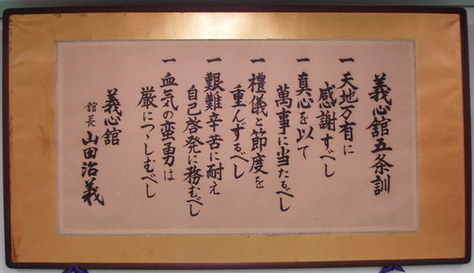
5 lessons of the Gishinkan
One should be grateful for all things in heaven and earth.
One Should be sincere in all things.
One should have respect for courtesy and moderation.
One should endure hardships and strive for self-enlightenment
One should strictly refrain from reckless ardour
Gishinkan President
Yamada Haruyoshi
What does it mean?
"One should be grateful for all things in heaven and earth"
天地 (tenchi) heaven and earth, is often used as a term to mean "all nature". I see this as a nice way of saying "be greatful for everything and don't take things for granted". This applies in and out of the dojo, so from a karate point of view, one should be greatful to teachers, training partners, of the lessons you are taught and opportunities to practice.
"One should be sincere in all things"
Be honest and genuine in your dealings with people. In karate one should be honest with yourself and put their all in to every technique. "hit with all your heart".
"One should have respect for courtesy and moderation"
One should have good manners "karate begins and ends with courtesy!" We bow at the begining and end of training. When one performs a kata, you bow at the begining and at the end, and in sparring with an opponent we bow at the begining and end to show respect and to thank our training partner. You should help keep the dojo clean and your equipment and gi in good repair. Having good manners and trying to be a nice person is a good method of avoiding trouble!
"All things in moderation" is a well known proverb, or "too much of a good thing". This is a warning to watch our diet, drinking or any habits we may have. Also dont over do our training as it can be harmful or even lead to injury if we train too hard too often!
"One should endure hardships and strive for self-enlightenment"
Our training can be hard and repetative, some may even get fed up and want to quit! We must sit it out and aim to improve. If you practice for a long time you will have peaks, troughs and plateaus in your practice. We must work past the lows to emerge better on the other side. In life too, working on yourself (or for yourself) will yeald results if you dont give up!
"One should strictly refrain from reckless ardour"
We should refrain from violence. Fighting is our last resort. We should control our temper and not get "hot blooded" or get carried away. Never be eager to fight.

義心館五条訓 - Gishinkan 5 lessons/precepts
一、天地万有に感謝すべし - One should be grateful for all things in heaven and earth (nature).
一、真心を以て萬事に当たるべし - One Should be sincere in all things.
一、禮儀と節度を重んじるべし - One should have respect for courtesy and moderation.
一、艱難辛苦に耐え自己啓発に努むべし - One should endure hardships and strive for self-development (self-enlightenment)
一、血気の蛮勇は厳につつしむべし - One should strictly refrain from reckless ardour (hot bloodedness)
義心館 舘長 - Gishinkan President (Kancho)
山田治義 - Yamada Haruyoshi